

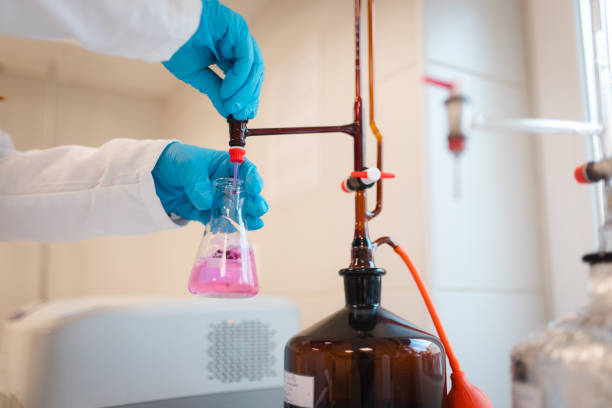
Titration is a cornerstone of analytical chemistry, allowing scientists to determine the concentration of an unknown solution by carefully reacting it with a solution of known concentration. One of the less straightforward but highly important titration types occurs when a strong base is titrated with a weak acid. Unlike the commonly studied strong acid-strong base titrations, this type exhibits unique characteristics, including a basic equivalence point and a noticeable buffer region. Understanding these nuances is essential for chemists, students, and laboratory professionals alike.
Understanding Strong Base-Weak Acid Titration
When a strong base, such as sodium hydroxide (NaOH), is gradually mixed with a weak acid, like acetic acid (CH₃COOH), a neutralization reaction occurs. The chemical reaction is:
OH−+HA→A−+H2O\text{OH}^- + \text{HA} \rightarrow \text{A}^- + \text{H}_2O
Here, OH⁻ comes from the strong base, HA is the weak acid, and A⁻ is the conjugate base produced. Since the acid is weak and only partially ionizes in water, the neutralization results in a solution that is slightly basic at the equivalence point.
Key Features:
-
The equivalence point is basic, typically with a pH greater than 7.
-
The pH change near the equivalence point is gradual, not sharp.
-
Requires phenolphthalein as an indicator instead of acidic indicators like methyl orange.
Principles Governing Strong Base-Weak Acid Titrations
The behavior of a strong base titrated with a weak acid is governed by a few key chemical principles:
1. Partial Ionization of Weak Acids
Weak acids do not fully dissociate in water. As a result, the concentration of hydrogen ions (H⁺) remains relatively low until most of the acid has reacted with the base.
2. Formation of a Buffer
During the titration, the solution contains both the weak acid and its conjugate base, forming a buffer that resists sudden pH changes. This buffer region is observed as a plateau in the titration curve.
3. Basic Equivalence Point
At the equivalence point, the solution contains only the conjugate base of the weak acid. Since this species can react with water to produce OH⁻ ions, the solution is slightly basic.
Titration Curve of Strong Base and Weak Acid
The titration curve illustrates how pH changes as a weak acid is added to a strong base. Its main characteristics include:
-
Starting Point: High pH due to the strong base.
-
Buffer Region: Slow decrease in pH as weak acid is added.
-
Equivalence Point: pH > 7; the curve rises moderately but does not drop sharply.
-
Beyond Equivalence: Further addition of weak acid gradually lowers pH.
Indicator Selection: Phenolphthalein is preferred because it changes color in the basic range (8.2–10.0), matching the equivalence point.
Calculating pH During Titration
Understanding the pH at various stages of titration is essential for accurate analysis.
1. Before Equivalence Point
Use the Henderson-Hasselbalch equation to calculate pH in the buffer region:
pH=pKa+log[A−][HA]\text{pH} = \text{p}K_a + \log \frac{[\text{A}^-]}{[\text{HA}]}
Where KaK_a is the acid dissociation constant of the weak acid.
2. At Equivalence Point
All the weak acid is neutralized, leaving only the conjugate base. The pH can be determined using the base hydrolysis formula:
pOH=12(pKw−pKa−logC)\text{pOH} = \frac{1}{2}(\text{p}K_w – \text{p}K_a – \log C) pH=14−pOH\text{pH} = 14 – \text{pOH}
Where CC is the concentration of the conjugate base.
3. After Equivalence Point
Excess weak acid gradually lowers the pH, but the solution is mostly basic until a significant amount of acid is added.
Choosing the Right Indicator
The correct indicator ensures precise detection of the equivalence point.
-
Phenolphthalein: Colorless to pink in pH 8.2–10.0, ideal for this titration.
-
Methyl Orange: Unsuitable, as it changes color in the acidic range and misses the basic equivalence point.
Factors Influencing the Titration
Several factors can affect the accuracy and shape of the titration curve:
-
Concentration of the solutions: Stronger solutions produce steeper curves.
-
Temperature: Alters dissociation constants and pH readings.
-
Purity of reagents: Impurities can lead to errors.
-
Indicator choice: Wrong indicators result in inaccurate endpoint detection.
Real-World Applications
Strong base-weak acid titrations are not just theoretical—they have practical importance:
-
Pharmaceuticals: Ensures proper pH levels in drug formulations.
-
Industrial Chemistry: Determines purity of acids or bases.
-
Environmental Science: Measures alkalinity in water sources.
-
Education: Demonstrates buffer zones and titration principles in laboratories.
Conclusion
Titrating a strong base with a weak acid presents a unique scenario in analytical chemistry, featuring a basic equivalence point, buffer formation, and gradual pH changes. Mastering the principles, calculations, and indicators for this titration is crucial for accurate laboratory work, industrial applications, and academic success. Understanding this type of titration deepens knowledge of acid-base chemistry and provides essential skills for practical chemical analysis.
FAQs
1. Why is the equivalence point basic in this titration?
Because the conjugate base of the weak acid remains in solution and slightly increases the pH.
2. Which indicator is suitable for a strong base titrated with a weak acid?
Phenolphthalein is best, changing color in the basic pH range of 8.2–10.
3. Can the Henderson-Hasselbalch equation be used here?
Yes, it is applicable in the buffer region before the equivalence point.
4. How does this titration differ from strong acid-strong base titration?
The equivalence point is above pH 7, and the pH change near equivalence is more gradual.
5. What are practical uses of this titration?
It is applied in pharmaceuticals, industrial chemical analysis, environmental testing, and educational laboratories.
