

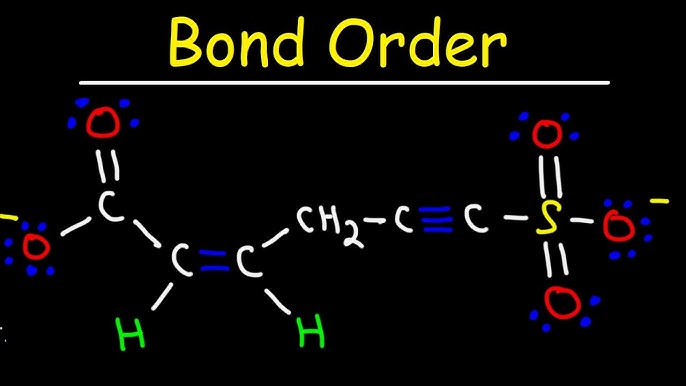
Understanding molecular structure is a crucial part of chemistry, and one of the most important concepts is bond order. But many students ask, “How do you determine bond order?” Bond order provides insight into the strength, stability, and length of chemical bonds between atoms. The higher the bond order, the stronger and shorter the bond, while a lower bond order often indicates a weaker connection.
In this article, we’ll explore all the methods to determine bond order, including simple formulas, Lewis structures, resonance theory, and Molecular Orbital Theory. By the end, you’ll be confident in calculating bond orders for various molecules.
What Is Bond Order?
Bond order refers to the number of chemical bonds between two atoms. It is a numeric measure of the bonding interaction:
-
Single bond → Bond order = 1
-
Double bond → Bond order = 2
-
Triple bond → Bond order = 3
In molecules with delocalized electrons or resonance, bond order can be fractional. For example, in benzene, the carbon-carbon bond order is 1.5 due to the shared electron density over multiple bonds.
Bond order also correlates with molecular properties: stronger bonds generally have higher bond orders and shorter bond lengths.
Why Bond Order Is Important
Knowing how to determine bond order helps chemists and students:
-
Predict Molecular Stability: Higher bond order usually indicates a more stable molecule.
-
Estimate Bond Length: Bond order inversely relates to bond length; higher order → shorter bond.
-
Understand Reactivity: Molecules with lower bond order tend to react more easily.
-
Interpret Molecular Properties: Physical and chemical properties often depend on bond strength and order.
How Do You Determine Bond Order?
There are several ways to calculate or estimate bond order depending on the type of molecule.
1. Using Lewis Structures
Lewis structures are a simple and visual way to determine bond order:
Steps:
-
Draw the Lewis structure for the molecule.
-
Count the number of bonds between the atoms of interest.
-
Divide the number of shared electron pairs by the number of bonding positions.
Example:
In O₂ (oxygen molecule), the Lewis structure shows a double bond between the two oxygen atoms.
-
Number of bonding pairs = 2
-
Bond order = 2 ÷ 1 = 2
This method is ideal for small molecules without resonance or delocalized electrons.
2. Using Resonance Structures
For molecules with resonance, bond order is calculated as an average of all bonds between two atoms:
Example:
In ozone (O₃), the Lewis structures alternate between single and double bonds:
-
Total bond order = (1 + 2) ÷ 2 = 1.5
This explains why both O–O bonds in ozone are identical and intermediate in length.
3. Using Molecular Orbital (MO) Theory
Molecular Orbital Theory is especially useful for diatomic molecules and molecules with unpaired electrons.
Bond Order Formula (MO Theory):
Bond Order=(Nb−Na)2\text{Bond Order} = \frac{(N_b – N_a)}{2}
Where:
-
NbN_b = Number of electrons in bonding orbitals
-
NaN_a = Number of electrons in antibonding orbitals
Example:
For O₂ molecule:
-
Bonding electrons = 10
-
Antibonding electrons = 6
-
Bond order = (10 − 6) ÷ 2 = 2
This confirms the presence of a double bond in O₂ and explains its stability.
Factors That Affect Bond Order
Several factors can influence bond order and help refine predictions:
-
Electron Configuration: More electrons in bonding orbitals → higher bond order.
-
Hybridization: The type of atomic orbitals involved can slightly affect bond strength.
-
Resonance: Delocalized electrons may create fractional bond orders.
-
Electronegativity Difference: Large differences may slightly weaken bonds despite higher bond order.
Examples of Determining Bond Order
Here are some common examples to illustrate how to determine bond order:
-
Nitrogen Molecule (N₂):
-
Triple bond → Bond order = 3
-
Carbon Monoxide (CO):
-
Triple bond → Bond order = 3
-
Ozone (O₃):
-
Resonance between single and double bond → Bond order = 1.5
-
Benzene (C₆H₆):
-
Delocalized electrons in a ring → Bond order = 1.5
-
Fluorine (F₂):
-
Single bond → Bond order = 1
These examples highlight that understanding how do you determine bond order allows chemists to explain molecular geometry, stability, and reactivity.
Tips for Accurately Determining Bond Order
-
Start with accurate Lewis structures or resonance forms.
-
Use MO theory for molecules with unpaired or delocalized electrons.
-
Remember that bond order may be fractional.
-
Compare bond orders to predict bond lengths and stability.
-
Practice with multiple molecules to gain confidence.
Conclusion
Determining bond order is an essential skill in chemistry. It provides insight into molecular stability, bond length, strength, and reactivity. Whether you use Lewis structures, resonance theory, or Molecular Orbital Theory, understanding how do you determine bond order equips you with the ability to predict chemical properties accurately.
By practicing with various molecules and applying these methods, you can master this concept and gain a deeper understanding of molecular structure and behavior.
FAQs
1. What is bond order?
Bond order is the number of chemical bonds between two atoms in a molecule and indicates bond strength and stability.
2. Can bond order be fractional?
Yes, molecules with resonance or delocalized electrons often have fractional bond orders.
3. How do you determine bond order using Lewis structures?
Count the total bonds between the atoms and divide by the number of bonding locations to calculate bond order.
4. What is the bond order formula in Molecular Orbital Theory?
Bond order = (number of bonding electrons − number of antibonding electrons)/2.
5. Why is bond order important in chemistry?
Bond order helps predict molecular stability, bond length, reactivity, and chemical properties.
